Zanzibar Locations & Things to Do: What's Worth It and What's not
Most Zanzibar travel guides are written by people who visited for a week and rated everything five stars. After living on the island for 18 months, here is my 5 cents on every major location and activity. From the boat tours actually worth your money to the viral spots you should skip.

The first time someone tried to sell me a Safari Blue tour, I was three days into island life, and I said no because I assumed anything that heavily advertised had to be a tourist trap. I did it eight months later with friends and spent the whole boat ride annoyed at myself for waiting.
That's the thing about a list of things to do in Zanzibar. Almost every one you'll find is written by someone who was on the island for a week, did six activities back to back, and rated all of them five stars because they had nothing to compare them against. I lived there for a year and a half. I did the good ones more than once, did the overrated ones so you don't have to, and worked out which ones are worth real money and which are worth an hour and a photo.
So this isn't a bucket list. It's a verdict on each Zanzibar location, from someone who stopped being a tourist somewhere around month three. If you want the safety side of traveling here alone, I covered that in Is Zanzibar safe for solo female travellers.
Zanzibar locations: the short version
Zanzibar Island (the main island, sometimes called Unguja) sits in the Indian Ocean off mainland Tanzania, a short hop by direct flights or fast ferry from Dar es Salaam. If you only have a week, the Zanzibar locations genuinely worth doing are Stone Town on foot, one boat day (a Safari Blue tour in the south or Mnemba in the north), a spice farm visit, Jozani Forest, and Prison Island once each. The rest is beaches, which is the actual point of a Zanzibar trip.
The single thing I'd tell you to skip is below, and it's probably the one you've already screenshotted. Now the detail.
Stone Town: visit this first, and on foot
Stone Town is where almost everyone lands, and I'd give it a full day at the start of your trip rather than saving it for the end. It's Zanzibar City's historic heart and a genuinely disorienting maze of narrow streets that phone maps give up on entirely…which is part of the pleasure once you stop fighting it.
Stone Town became a UNESCO World Heritage Site in 2000, and this UNESCO-listed site is known for its mix of African, Arab, and European architecture, which is exactly what makes wandering it feel like walking through three continents at once. You'll pass local artists selling work in doorways, spice stalls, and the famous carved doors on nearly every corner.
Book a walking tour to explore Stone Town on your first morning. Not because the town is dangerous in daylight, but because a good guide hands you the layout, the history, and the confidence to wander at your own pace afterwards, and it's the easiest way to meet other travellers you might share a boat day with later. Most tours run two to three hours and cover the old fort, the former slave market and the cathedral built over it, and the Palace Museum along the seafront.
The old fort and the slave market site are the two I'd prioritize if you're short on time. The Old Slave Market in Stone Town closed in 1873, and the memorial and cathedral built on the site are the most honest thing on the island about how Stone Town's wealth was actually built. It is not a comfortable visit and it isn't meant to be. It stayed with me longer than any beach did.
If you want to see where the island actually shops rather than where it sells to tourists, walk through Darajani Market, established in 1904 and still the main market in historic Stone Town. It's loud, pungent, and completely unbothered by your presence. Go in the morning when the fish and produce are fresh, and note that spices here are often much cheaper than on a spice farm visit.
Come evening, the Forodhani Gardens night market sets up along the water. I've written more about the local food below, but as a thing to do, it's the easiest solo evening in Zanzibar: busy, well-lit, and full of people. It's also where you'll find Zanzibar pizza, which is nothing like pizza and worth trying once.
Zanzibar locations: the beaches, ranked by who they're for
Zanzibar's coastline changes character completely depending on which coast you're on, and picking the wrong one for your trip is the most common mistake I saw people make. The best beaches split cleanly between the north coast and the southeast coast, with the east coast and west coast serving different crowds again.
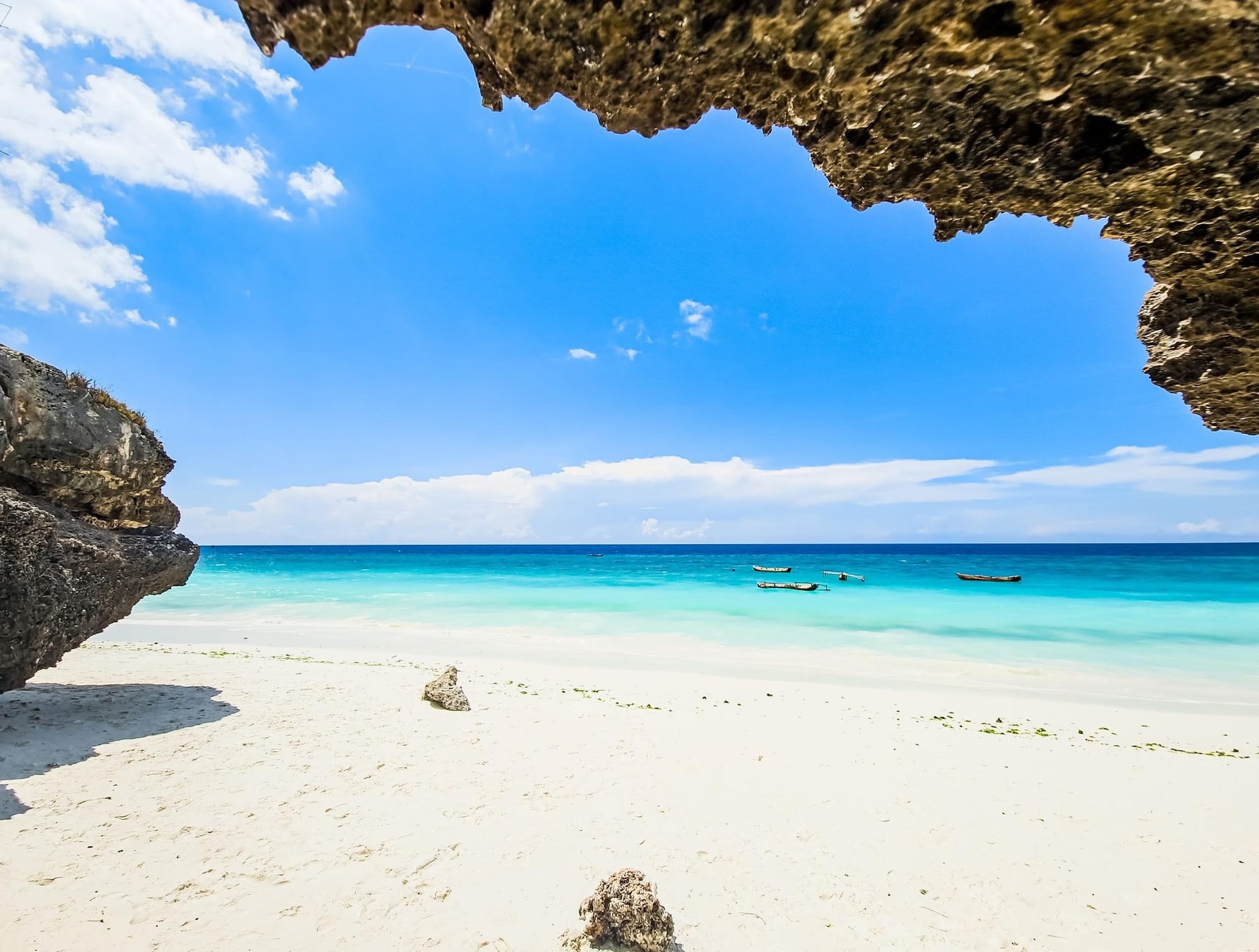
Nungwi Beach, on the north coast at the island's western tip, is where I based myself for over a year, so I'm biased, but it earns it. It's one of the few white sand beaches where the tide doesn't retreat half a kilometer at low water, which means you can actually swim all day. A bigger deal than it sounds if you've ever crossed wet flats and sea urchins to reach the sea. Good beach bars, good local food, palm trees, a real fishing village still working alongside the tourism, and easy to meet people. This is my pick for a first trip and the best base on the island.
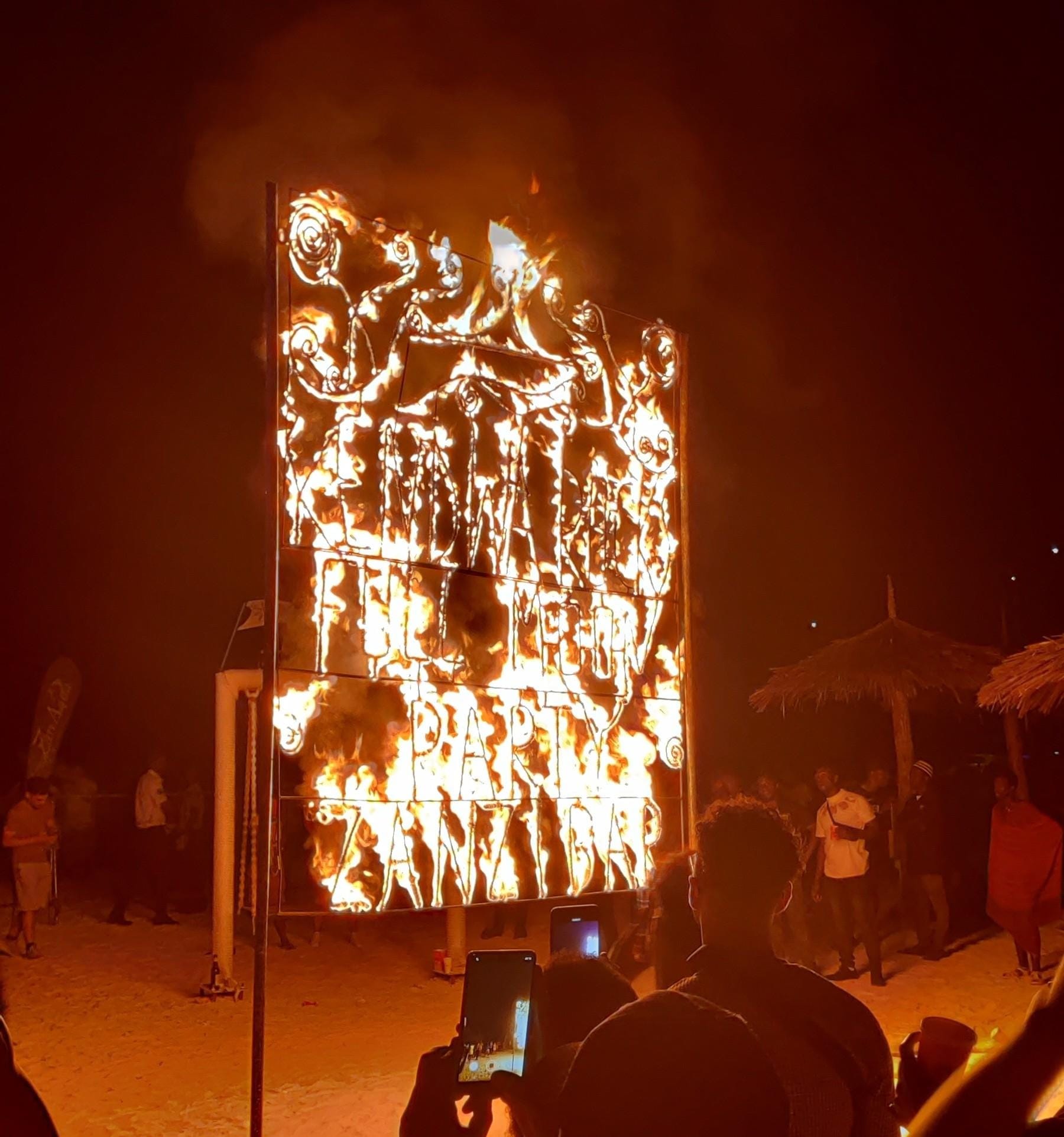
Kendwa Beach is Nungwi's quieter neighbor, a few minutes down the same northwestern tip, with the same all-day swimming and a calmer feel until the Kendwa Rocks full moon party, the island's biggest beach night and genuinely good fun if that's what you're after. I went for the full moons and a few dinners. I never stayed over, but as a night out, it delivers big time.
Paje Beach, on the southeast coast, is the kite surfing capital and the best base if you want a younger, more independent-traveller crowd. The tide goes right out here, so it's less about lazy swimming and more about the flat, wide, cinematic beach and the wind. Stunning white sand beaches, powdery underfoot, and the water when it's in are the postcard turquoise everyone comes for.
Jambiani, just south of Paje on the same southeast coast, is a beautiful & quiet, but I'd point a first-time solo traveller elsewhere. My personal reasons are in the safety guide, but the short version is that it's spread out and there's not much around you.
Kiwengwa, further up Zanzibar's east coast, is resort territory. Big all-inclusives and boutique hotels, lovely sand, less to walk to. Fine if you want to not think, less good if you want a village around you. If it's a rooftop terrace and a boutique hotel you're after over a village, this is your beach area.
A note for anyone chasing the most idyllic beaches: the further south you head down the south coast, the quieter and emptier it gets, but also the more spread out and car-dependent. There's a trade-off between seclusion and having a beach bar within walking distance, and only you know which side of it you want.
Safari Blue tour: the boat day worth the money
The Safari Blue tour is the full-day dhow trip out of the south of the island, and it's the one organized activity I'd tell you to actually spend on. You sail a traditional dhow into the Menai Bay conservation area, snorkel a proper reef full of tropical fish, swim in a mangrove lagoon, and eat a seafood BBQ on a sandbank in the middle of the Indian Ocean.
I did it with friends about eight months in, and it was one of my best days on the island. The kind of day that's worth the group-tour awkwardness because the setting does all the work.
Expect to pay somewhere around USD 80-100 per person for a standard group joining, with private charters running higher. That usually includes hotel pickup, all the snorkel kit, the lobster BBQ and fruit, and the marine reserve entry.
Two things worth knowing: tips for the crew aren't included, and the original operator out of Fumba is the one legally allowed to use the "Safari Blue" name, so if you care about that, book direct rather than through a beach boy.
Mnemba: the snorkelling and diving that's actually worth it
Mnemba is a tiny island off the northeast, ringed by the best reef in Zanzibar, and the atoll around this small island is where you go for serious scuba diving and snorkeling. You can't land on the island itself (it's an exclusive resort), but the marine life in the water around it is the real draw anyway.
I went out to Mnemba with a group of friends, and it more than lived up to it: clear water, huge amounts of tropical fish, and, if you're lucky, dolphins on the way out. The diving here is genuinely amazing diving by any standard, not just a Zanzibar standard. If you only do one snorkel or dive trip and you're staying up north, this is the one.
If you're based in the south, the Safari Blue tour makes more sense logistically—it gets you a great day on the water. Check out this GetYourGuide offer for only $19 per person.
The spice farm visit: touristy, but still worth an afternoon
The spice tour is the most-sold excursion on the island, and I resisted it for months because it sounded like a coach-tour cliché. It mostly is. It's also genuinely interesting and cheap enough that the touristy edge doesn't matter. This is the tour that connects the island's history to the wider spice trade across the Middle East and East Africa. Book your Spice tour here.
You walk a working spice farm, part tropical garden and part outdoor classroom, crushing leaves and bark and fruit to guess what they are, learning far more about cloves and green pepper than you strictly need to, and coming away understanding why this island's whole history (the good and the brutal) was written around spice.
Most spice farm visits run around USD 15–25 (I booked one for 19 USD at my hotel back then) and take a couple of hours, often with a local lunch tacked on. Book through your accommodation rather than the first man who offers on the beach, and you'll pay the fair price.
Jozani Forest and the Zanzibar red colobus monkeys
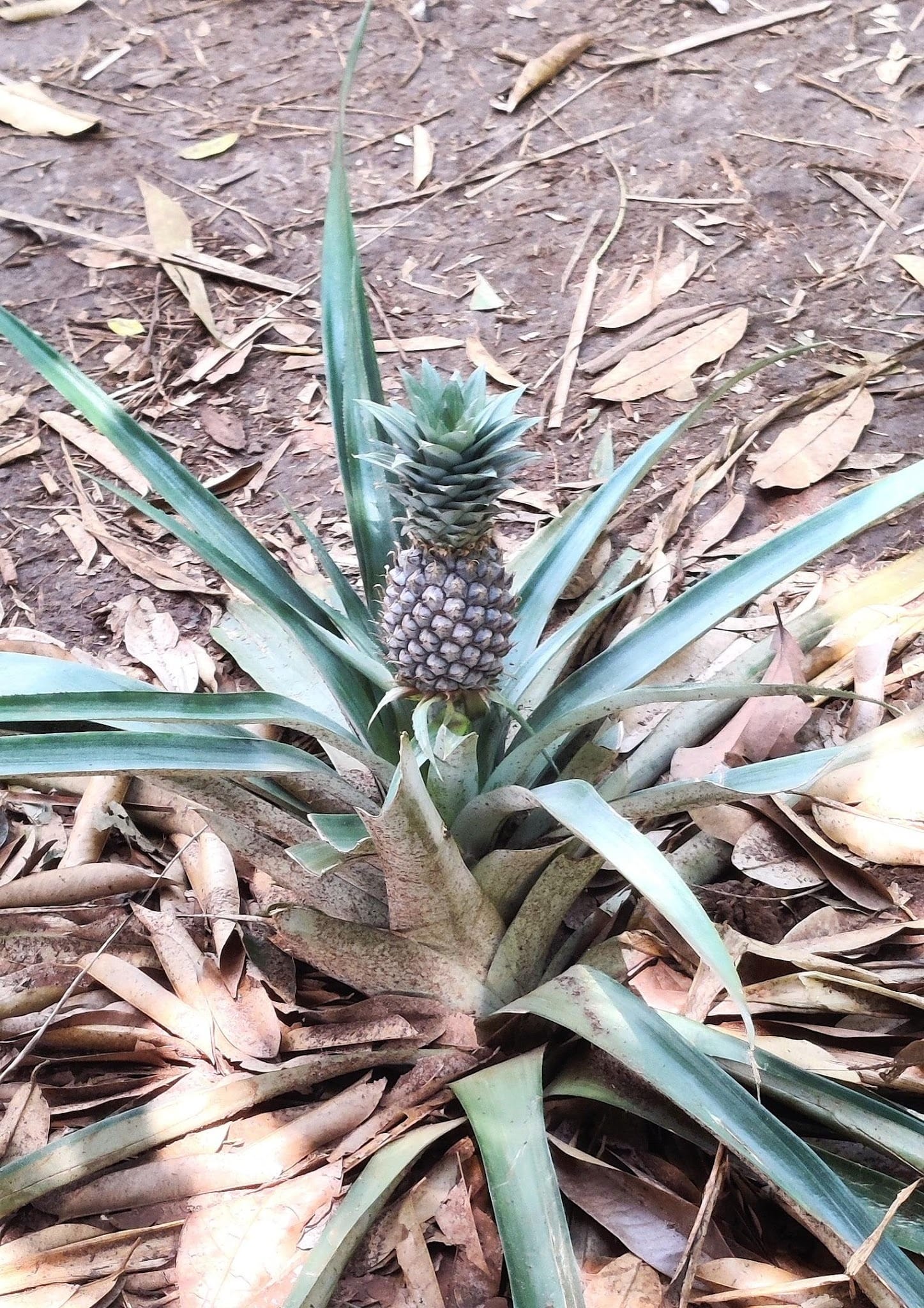
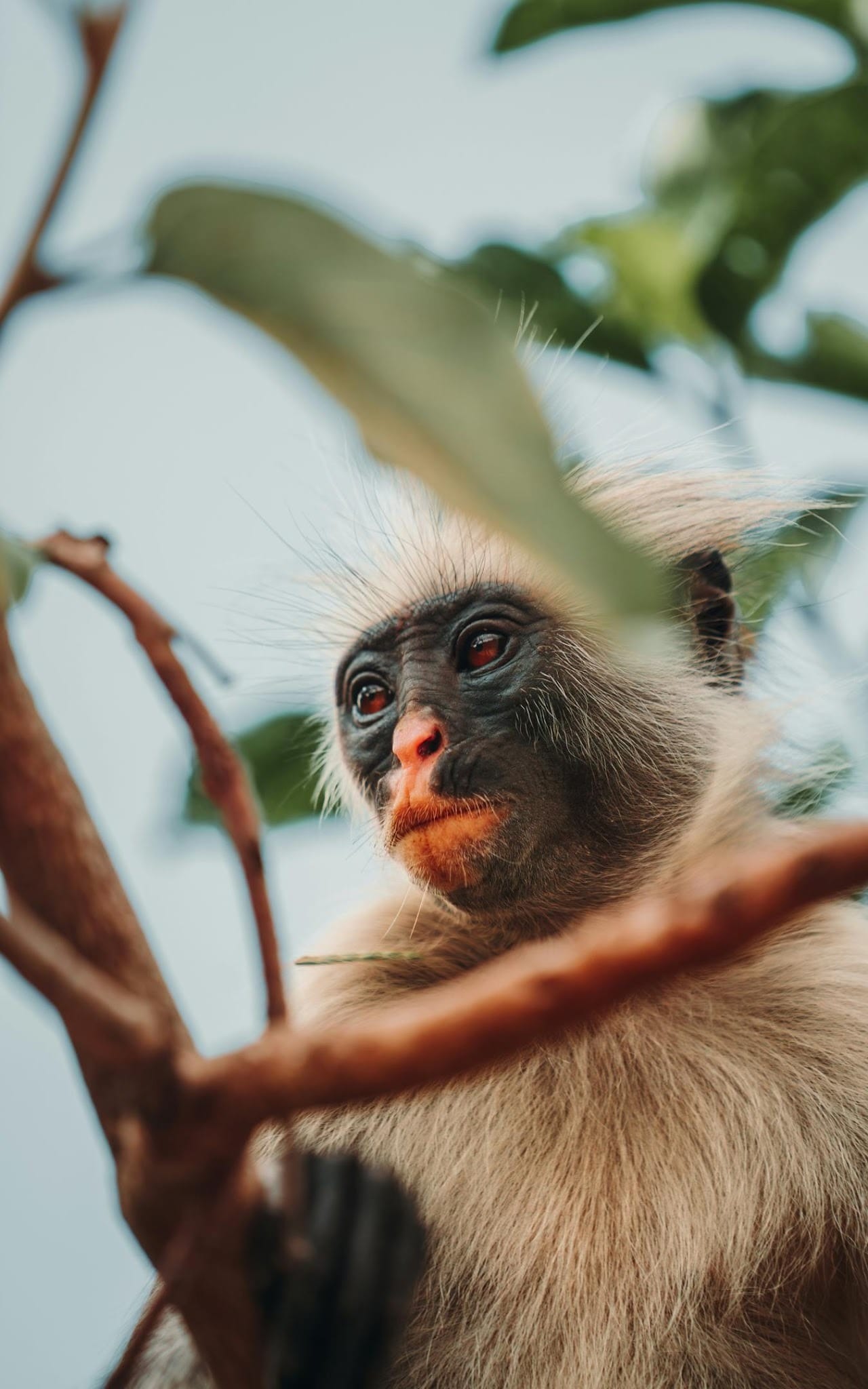
Jozani is the island's only national park and the last stronghold of the Zanzibar red colobus monkeys, a species that exists nowhere else on earth. It's a small forest, and you don't need long (an hour or two on the boardwalks), but it's a lovely, easy, genuinely worthwhile break from the beach, and the colobus troops are habituated enough that you'll see them close without anyone baiting them to perform.
Do it once. It sits between Stone Town and the southeast coast, so it slots into a transfer day without costing you a beach day — an easy win on any Zanzibar itinerary. Book your Jozani Forest tour here.
Prison Island and the giant tortoises
Prison Island—Changuu—is a short boat hop from Stone Town and worth doing once. The name is grim (it was built as a prison and later a quarantine station and never really used as either), but the reason to visit Prison Island is the colony of giant Aldabra tortoises, some of them well over a century old. Entry to the sanctuary on this tiny island is only a few dollars; the cost is really the boat over, which you'll negotiate at the Stone Town waterfront or bundle into a tour.
It's touristy and it's brief, and it's still a genuinely nice half day, especially if you're already spending time in Stone Town. The giant tortoises are enormous and entirely unbothered by you, which is its own kind of calming.
The one to skip: The Rock restaurant
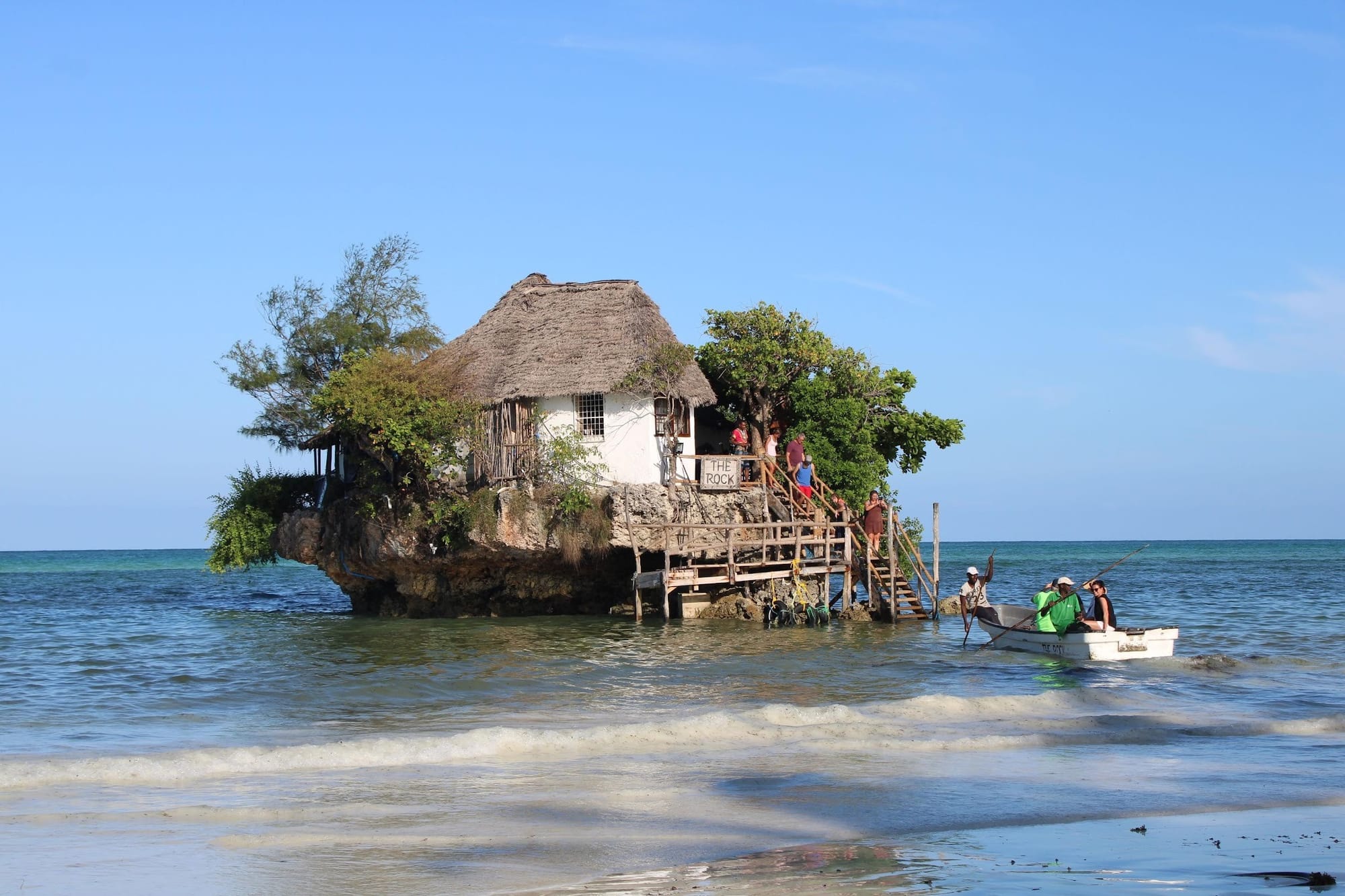
You've seen the photo. Everyone has. The little Rock restaurant, perched on a rock in the ocean off the southeast coast, the single most Instagrammed spot on the island. I went. I'd tell you to save your money.
Here's my take on it: The setting is lovely for about fifteen minutes and a few photos. But the food is expensive out of all proportion to what it is: mains run roughly USD 25–45, specials climb past USD 80, and a full meal with a drink lands somewhere around USD 60–90 a head. For that, the food is underwhelming, and the place itself isn't nearly as high-end as the prices imply. It's a photo opportunity that happens to serve dinner, and you're paying for the picture.
If you want one special meal on the water, take the money you'd have burned at The Rock and put it into a private sunset dhow cruise with dinner instead. You'll get the same ocean, a better meal, and a fraction of the crowd. And nobody's rushing your table for the next booking. Go to The Rock for a single beer at the bar and the photo if you must. Don't go for dinner.
And the one to genuinely avoid: the Nungwi turtle "sanctuary"
I want to be straight about this one because it gets recommended constantly, and I found it grim.
The Mnarani turtle attraction in Nungwi is sold as a conservation sanctuary, and the experience on offer is that tourists feed the turtles and swim in the enclosure with them. I went once and didn't stay long. The water was dirty; the animals are handled and fed by a rotating crowd of visitors all day, and the whole thing sat badly with me in a way the wild marine life around Mnemba never did.
I'm not going to tell you it's cruel as a matter of fact, because I'm a travel writer and not a marine biologist. I'll tell you what I saw and what I felt, which is that swimming in a murky enclosure with animals being fed for photographs is not the wildlife experience it's dressed up as. If you want turtles, you'll see them in the open water on a snorkel trip, living as they should. I'd give this one a miss.
What about Pemba Island?
One question I got a lot: is Pemba Island worth adding on? Pemba is the archipelago's other main island, north of Unguja, greener and far less visited, and it has a reputation among divers as some of the best, quietest diving in East Africa. I never made it across, so I won't pretend to first-hand knowledge. But travellers I trusted came back raving, and if you dive seriously and want somewhere with almost no crowds, it's the one I'd research next. For a first Zanzibar trip, though, stick to the main island; there's more than enough here. In case you want to fly out to Pemba Island anyways, there is some tour providers on Get-Your-Guide, with really good reviews.
A rough first-timer's Zanzibar itinerary
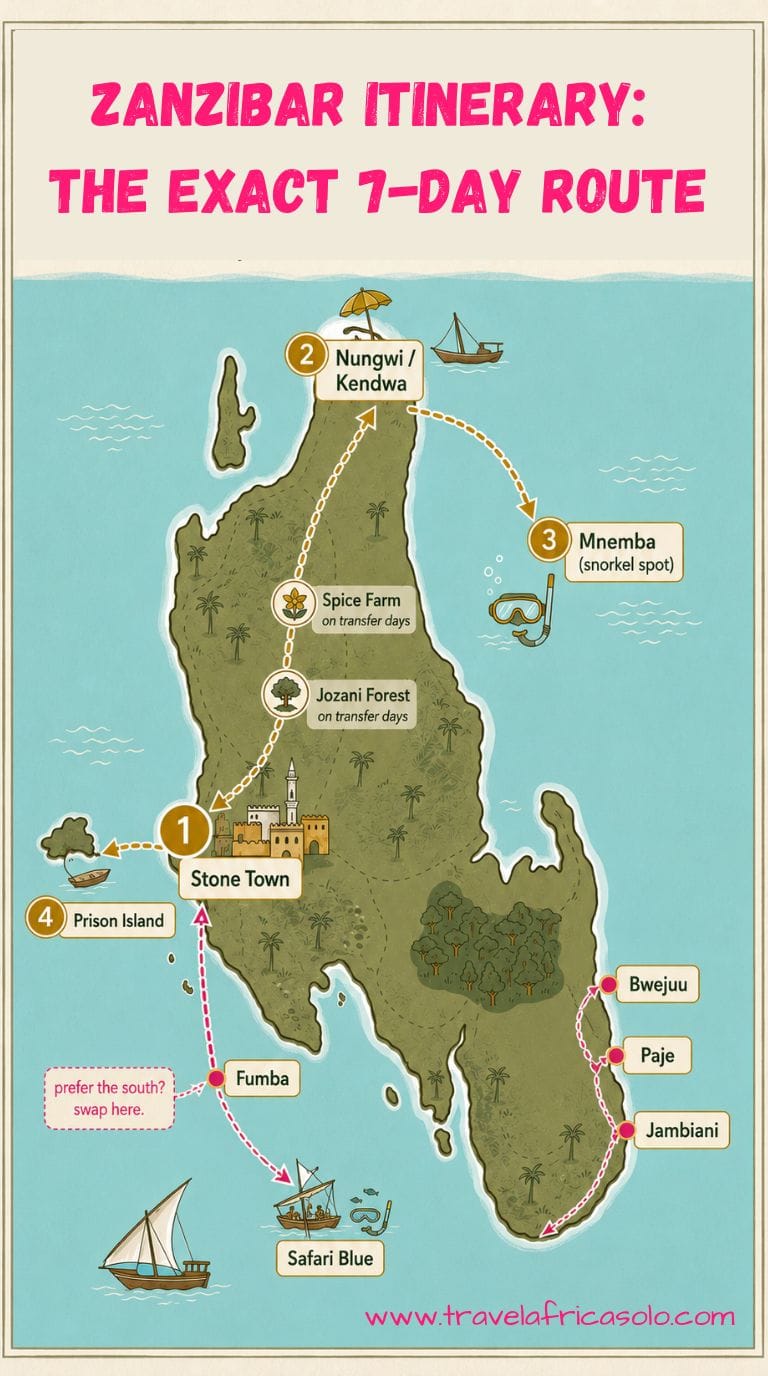
If you want the whole thing as an itinerary rather than a menu: land in Stone Town, do the walking tour and a night at Forodhani, then head north to stay in Nungwi or Kendwa for beach days and one boat trip out to Mnemba. Slot the spice farm and Jozani into your transfer days rather than spending beach time on them, and keep Prison Island for a spare morning back near Stone Town before you fly. If you'd rather head south, swap Nungwi for Paje and Mnemba for the Safari Blue tour.
That's roughly how I'd spend a week if I were arriving fresh, and it's built around the things I'd actually do again—which, after eighteen months, is the only recommendation I trust.
The practical bit
Getting between all this. There's no Uber on Zanzibar, so you're relying on taxis with the fare agreed before you get in or transfers arranged through your accommodation. I broke down the real prices I paid—Nungwi to Stone Town, Stone Town to Paje, and the rest you'll find in the safety guide, along with why I never recommend renting a scooter here.
Getting there. Direct flights land into Zanzibar from a growing list of European and Middle East hubs, and there's a steady stream of flights and fast ferries from mainland Tanzania if you're combining the island with a Tanzania safari.
When to go. June to October is the dry, reliable window and the best all-round time. December to February is hot and excellent. March to May is the long rains, when a lot of places close and the sea turns rough. Check the Ramadan dates for your travel year, since daytime eating and opening hours shift.
How long you need. A week gets you Stone Town, a boat day and real beach time without rushing. Ten days lets you add the south as well as the north. Anything less than five days and you'll spend half of it in transfers.
Booking excursions. Book through your accommodation, not the beach. You'll pay the fair price, you'll have a name attached if something goes wrong, and you skip the negotiation entirely.
So, which Zanzibar locations are worth the visit?
Most things-to-do lists treat Zanzibar as a set of attractions to tick off. It isn't. It's a beautiful island where the best day is usually an unstructured one—a swim, a long lunch of fresh fish, a boat you didn't plan on. Do Stone Town properly, spend real money on one good day out on the Indian Ocean, see the spice farm and the forest and the tortoises once each, skip The Rock, and give the rest of your time to the beach.
That's what I did, more or less, for a year and a half. I never ran out of it.
Planning the wider trip? Start with The Ultimate Africa Travel List, or read the honest Zanzibar safety guide for solo women before you book.
Quick answers to your questions:
What are the top things to do in Zanzibar?
Explore Stone Town on foot, do one boat day (a Safari Blue tour in the south or Mnemba in the north), take a spice farm visit, walk Jozani Forest to see the red colobus monkeys, and visit Prison Island for the giant tortoises. Beyond that, the beaches are the main event. Nungwi and Kendwa on the north coast for swimming and Paje on the southeast coast for kitesurfing.
Is The Rock restaurant worth it?
In my view, not for a meal. The setting is beautiful for a photo, but mains run USD 25–45 for food most guides, including me, found underwhelming, and a full dinner lands around USD 60–90 a head. Go for one drink at the beach bar and take the picture. Put your dinner money into a private sunset dhow cruise instead.
How many days do you need in Zanzibar?
Five at an absolute minimum, a week comfortably, ten days if you want both the north coast and the southeast coast. Fewer than five and transfers eat on your trip.
What's the best area to stay in Zanzibar?
Nungwi on the north coast if you want to swim all day and have a village around you; Paje on the southeast coast for kitesurfing and an independent traveler crowd; and a night or two in historic Stone Town at the start for the local culture.
Is Pemba Island worth visiting?
Pemba Island, the archipelago's greener and quieter main island north of Unguja, is known for some of the best, least-crowded scuba diving in East Africa. I didn't make it across myself, but serious divers I trust rate it highly.
Which are the best beaches in Zanzibar?
The best beaches depend on what you want. Nungwi Beach and Kendwa Beach on the north coast have white sand and deep water you can swim in all day. Paje Beach on the southeast coast is flatter, windier, and built for kitesurfing. For the most idyllic, empty stretches, head south down the southeast coast, though you'll trade a beach bar within walking distance for the seclusion.